
Preserving nearly 175 years of faith: The Very Rev. Justin Pino’s chalice story
By Melanie Sisinni
05/07/2026
Long before he became pastor of St. Leo Parish in Ridgway, Father Justin Pino was a boy memorizing presidents and reading encyclopedias. At eight, he announced with certainty that he would become a priest, and more specifically, the diocesan archivist. History was never a hobby. It was a way of understanding how the past still shapes the present.
That instinct is nowhere more visible than in the two chalices that anchor his priesthood.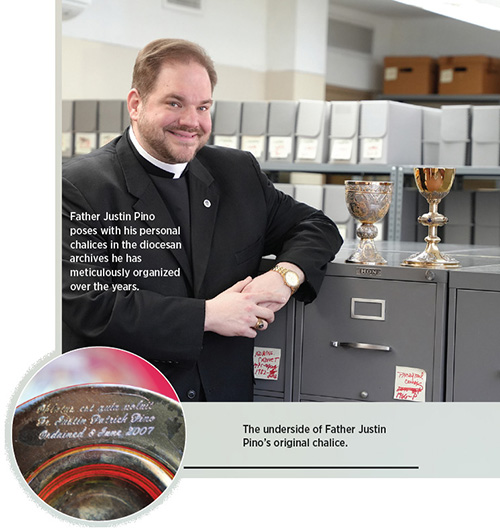 His ordination chalice, used exclusively during high holy days, is modeled after the ancient Tassilo Chalice. Gold and silver tones frame icon-style images. Beneath it, engraved in Latin, are words from the prophet Isaiah he saw daily during formation at St. Mary’s Seminary and University in Baltimore: Oblatus est quia voluit — “He offered himself because He chose to.”
The chalice also carries something more personal. It is engraved in memory of his maternal grandfather, Leonard Mick, the only grandparent not physically present at his ordination.
His second chalice is newer and even more intimate. Purchased after his mother’s death in 2023, the early 20th-century piece was redesigned by jeweler and friend, Shawn Dahlkemper. Blue stones reflect the September birthstones of his parents, Patrick and Kathleen. Most strikingly, their wedding rings are soldered together and fitted into a small hollow beneath the base.
“There’s always something below the surface,” said Father Pino.
That way of seeing extends beyond the altar. It reaches down the hallway at the diocesan offices, into labeled boxes, aging photographs and nearly 175 years of diocesan history.
As an 18-year-old seminarian at St. Mark Seminary, Father Pino introduced himself to then-archivist Msgr. Robert Barcio by bringing a copy of Barcio’s Cathedral in the Wilderness and asking for an autograph. A friendship followed, and Father Pino began assisting in the archives.
“It was very natural,” he said of assuming the role of archivist in 2010. “We became extremely close.”
Nearly 16 years later, that enthusiasm for history has not faded. His office shelves are lined with carefully labeled boxes and acid-free folders, the result of a painstaking reorganization effort. Every staple and paperclip has been removed, documents rehoused for long-term protection and files carefully relabeled.
“If I could be here every single day, I would,” he added. “I don’t consider this work.”
His years of labor have a distinct purpose. In 2028, the Diocese of Erie will celebrate its 175th anniversary, and Father Pino hopes to mark the milestone with a new comprehensive history.
“I want to write a single, one-volume history from the beginning to the present,” he said. “Something accurate, readable and complete for the 175th. It’s time to tell the whole story in one place.”
He often finds handwritten notes from earlier archivists, including Msgr. Richard Guilfoyle, who left Erie in 1936 to become bishop of Altoona (now Altoona-Johnstown), noting items they were unable to locate. Decades later, Father Pino is often able to supply what was missing.
“I’ll look at his picture on the wall and say, ‘I found it.’ It feels like putting a period at the end of his sentence.”
Among the carefully preserved items in the archives are about 20 chalices entrusted to the diocese from closed parishes or deceased priests. When a newly ordained priest needs one, he lends it with a simple stipulation.
“Once a year on the anniversary of the priest’s ordination who it belonged to, you say Mass for him. That’s the payment we need,” says Father Pino.
He includes a photograph and brief biography of the original owner. Memory becomes prayer. History is living.
That conviction also shapes the way he celebrates the liturgy. Gold chalices rest during Lent in favor of silver. Special pieces appear only for Christmas, Easter and solemn feasts, preserving what he calls a sense of wonder.
“It’s like incense,” he said. “If you use it every day, it loses some of that mystical quality.”
For Father Pino, the objects entrusted to him are never simply things.
“I’ve never seen an inanimate object in my entire life,” he said. “Every object I’ve ever seen is alive with a story.” 11
-